


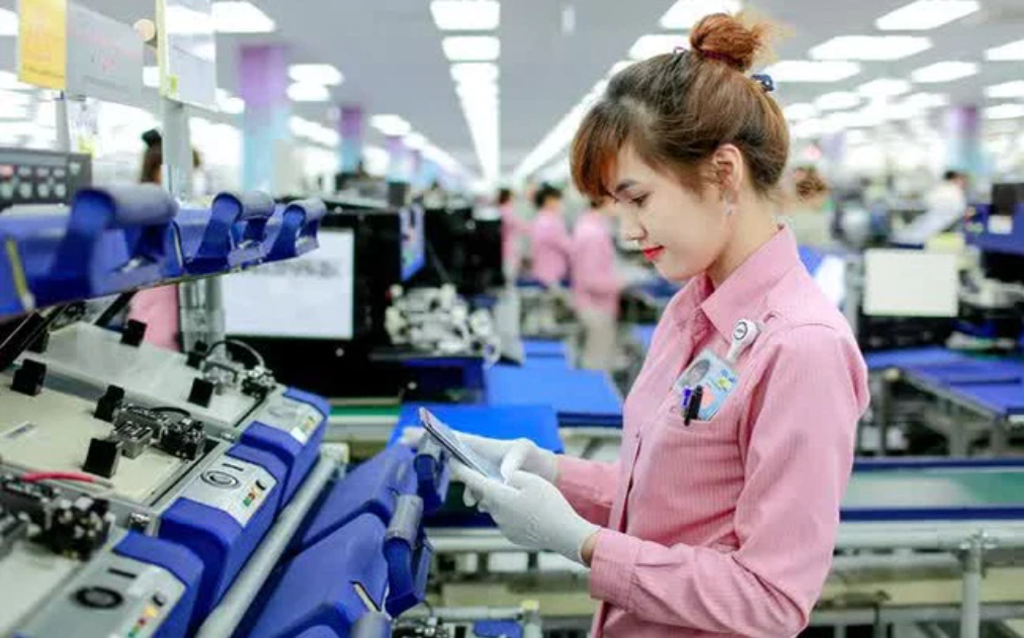
According to Sputnik News, Vietnam is drawing increasing attention amid expectations that it will become the world’s next manufacturing hub.
Shifting from the “Zero COVID-19” approach to “safely living with the pandemic,” Vietnam has demonstrated a suitable direction as its economy continues to recover. This not only helps the economy quickly regain growth momentum, but also strengthens the confidence of foreign investors operating in Vietnam.
In the spirit of “harmonized benefits and shared risks,” many foreign investors still consider Vietnam a promising market for development. Despite the negative impacts of the pandemic, Vietnam has maintained its position in the global supply chain. In the first month of the new year, realized FDI reached more than USD 1.6 billion, up 6.8% year-on-year.
“Vietnam is the world’s new manufacturing base” is the headline of a recent article published by Russia’s Sputnik News. The article noted that Vietnam is gaining more attention with expectations of becoming a new global production center. Vietnam’s exports have reached record levels, with many “Made in Vietnam” products appearing in increasing volume and market share on the international stage.
The article cited Samsung Vietnam’s 2021 business report, affirming that “Vietnam has become a global manufacturing hub with a long-term investment strategy, and Hanoi has become Samsung’s largest R&D center in Southeast Asia.”
A recent analysis by the Korean news platform Koreaherald reaffirmed that Vietnam is Samsung Electronics’ largest smartphone manufacturing base. In 2021, 50% of Samsung’s global smartphones were produced in Vietnam. Despite the difficulties caused by the pandemic, Samsung Vietnam still achieved 14% growth in 2021, reaching over USD 74 billion in revenue, with export turnover increasing by 16%.
“One of the factors that enabled us to achieve such encouraging business results is the comprehensive support from the Vietnamese Government and local authorities. As a result, our production process was not disrupted even during the most challenging period of the pandemic. Samsung always trusts Vietnam’s superior investment environment and will not change our business strategy here. By the end of 2021, Samsung Vietnam’s accumulated investment capital reached USD 18 billion. While Samsung previously invested mainly in production lines, in the coming period we will elevate Vietnam to a new level—becoming a strategic research and development hub,” said Choi Joo Ho, General Director of Samsung Vietnam Complex.
Recently, CNBC and Bloomberg cited the financial report of Nike, the world’s leading sportswear brand, noting that in 2021, Vietnam accounted for 51% of Nike’s global production volume.
“We can clearly see Vietnam’s strong appeal to FDI investors. The COVID-19 pandemic shows that we need to diversify supply chains, and Vietnam is one of the most promising candidates. Many major corporations have moved to Vietnam. I believe Vietnam will continue to capitalize on its competitive advantages,” assessed Jacques Morisset, Lead Economist of the World Bank in Vietnam.
Not only Samsung, Nike, and Intel, but many major manufacturing projects from multinational corporations such as Foxconn, Pegatron, and Lego are increasingly appearing in Vietnam. Panasonic recently relocated its refrigerator and washing machine production plant from Thailand to Vietnam. Meanwhile, long-established manufacturers have also planned to expand production.
“Vietnam occupies an important position in the global supply chain. We highly appreciate the Vietnamese Government’s strategic shift from ‘Zero COVID-19’ to flexible and effective adaptation. In the long term, Vietnam remains an attractive investment destination for Japanese businesses—not only due to its stable political and economic environment and competitive costs, but also thanks to the quality of its workforce and opportunities brought by the free trade agreements Vietnam has signed,” said Takeo Nakajima, Chief Representative of JETRO Hanoi.
Emerging markets like Vietnam can present strong growth potential for investors. This assessment was highlighted in an article published on the U.S.-based ETF Trends on February 8. According to the article, although COVID-19 has deeply affected emerging markets, some countries that responded quickly were able to minimize economic losses. The article emphasized that Vietnam is a notable example thanks to its swift and decisive government action.
“The pre-pandemic trend of shifting business operations and supply chains to Vietnam is being restarted. The U.S.–ASEAN Business Council has decided to send a delegation of companies to visit Vietnam, meet with Government leaders and ministries to discuss investment plans and opportunities, instead of having to hold virtual meetings like last year,” said Vu Tu Thanh, Deputy Regional Managing Director of the U.S.–ASEAN Business Council.
“In 2022, investment from South Korea into Vietnam may reach USD 10 billion. This year, several major projects could materialize, especially in the energy sector, with scales ranging from USD 3 to 6 billion. We are certain that we will continue expanding our investments,” said Hong Sun, Vice Chairman of the Korea Chamber of Business in Vietnam (Korcham).
Despite the ongoing and unpredictable developments of COVID-19, Vietnam’s stable macroeconomic foundation and timely government policies for pandemic prevention and control have created an important premise for the economy to move firmly into 2022.
The assessments of international experts and media outlets over the past week show that Vietnam’s economy has been and is regaining strong growth momentum. Upcoming reopening signals are also expected to create new drivers for Vietnam’s growth in the post-pandemic “new normal.”
Source: Cafef